Hesai and JD.com Partner on Physical AI
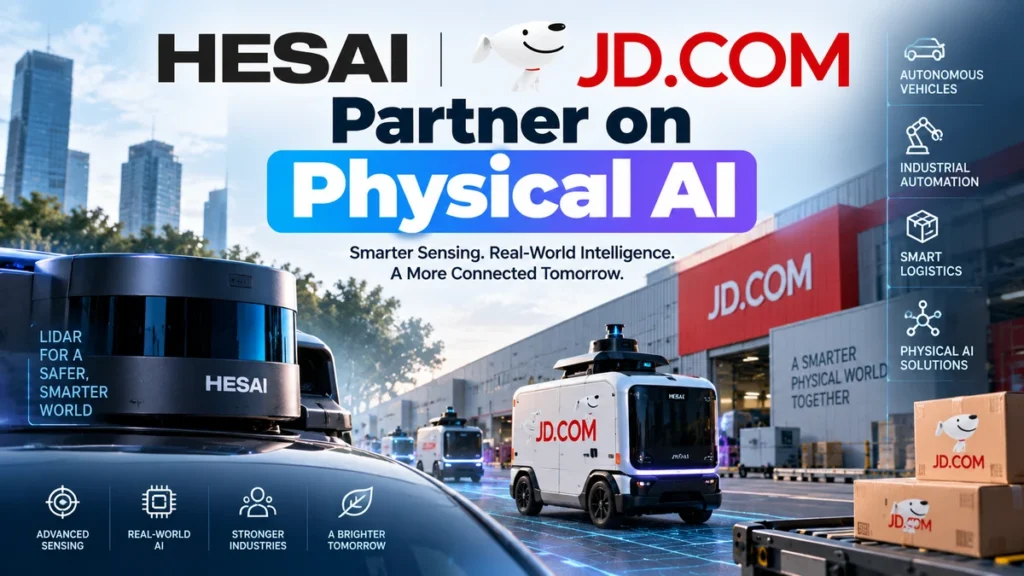
Hesai Technology and JD.com expand partnership to advance physical AI applications and innovation.
physical AI applications
LiDAR Meets Logistics: A New Era of Smart Automation
When two tech giants decide to work closer together, it usually means something big is brewing. Hesai Technology, a leader in LiDAR sensor manufacturing, has deepened its cooperation with JD.com, China’s e-commerce and logistics powerhouse, to push the boundaries of what physical AI can accomplish.
The partnership signals a shift in how companies are thinking about artificial intelligence. Rather than keeping AI confined to software and cloud systems, both companies are focusing on bringing intelligent capabilities directly to the physical world—where robots, autonomous vehicles, and smart machines actually operate.
Why LiDAR Matters for Physical AI
LiDAR sensors are the eyes of autonomous systems. They create precise 3D maps of environments in real-time, allowing machines to navigate, detect obstacles, and understand their surroundings with remarkable accuracy. For a logistics company like JD.com, this technology is essential for automating warehouses and delivery operations.
Hesai’s advanced sensor technology provides the perception layer that physical AI systems desperately need. Without reliable, high-performance sensors, even the most sophisticated AI algorithms can’t function effectively in real-world conditions.
What This Partnership Means for the Industry
This collaboration goes beyond a simple vendor-buyer relationship. Both companies are investing in joint research and development to create integrated solutions tailored for e-commerce, logistics, and autonomous delivery applications.
JD.com’s massive infrastructure and real-world operational challenges provide the perfect testing ground for Hesai’s sensor innovations. Meanwhile, Hesai gains access to practical applications and large-scale deployment opportunities that accelerate product refinement.
Real-World Applications Taking Shape
The partnership is likely to produce tangible results in warehouse automation, autonomous delivery vehicles, and smart sorting systems. These aren’t theoretical projects—they’re solutions that JD.com can deploy across its sprawling logistics network.
For consumers, this means faster deliveries and more efficient supply chains. For the tech industry, it demonstrates how specialized hardware companies and platform operators can work together to advance physical AI capabilities.