Marketing SaaS in 2026 is no longer about collecting tools. Most teams already have access to more software than they can properly integrate. The real constraint has shifted from availability to system design—how well your tools actually work together to produce predictable revenue outcomes.
The difference between average and high-performing teams is not the stack itself, but how the stack is structured into workflows that reduce friction, improve decision speed, and remove manual dependencies.
This article breaks down the best marketing SaaS tools in 2026 not as a list, but as a working system.
The Modern Marketing Stack Is a System, Not a Collection
A functional SaaS stack today operates across five layers:
- Data capture layer (traffic + intent collection)
- Activation layer (lead conversion + engagement)
- Automation layer (routing + sequencing)
- Optimization layer (testing + analytics)
- Revenue layer (CRM + attribution + forecasting)
Most failures happen when tools exist without clear responsibility in one of these layers. For example, having both HubSpot and multiple email tools without a defined routing logic creates duplication instead of efficiency.
The goal is not to add tools. It is to reduce decision latency between user behavior and system response.
Core Infrastructure Layer: Where Everything Starts
At the foundation, you need tools that reliably capture and structure data without distortion.
Modern setups typically rely on:
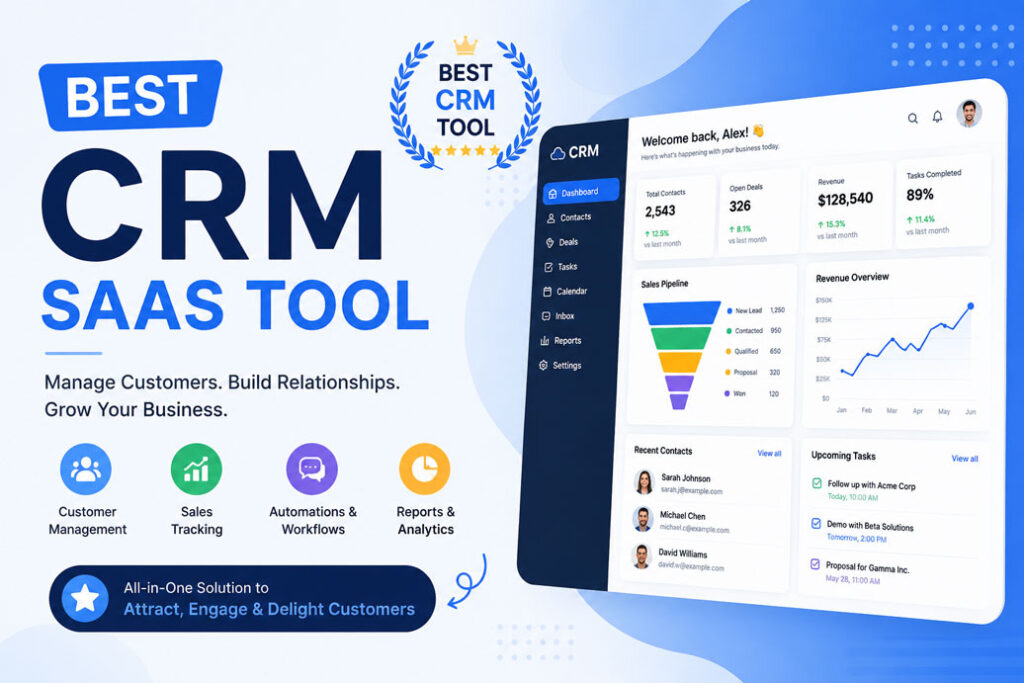
CRM platforms like Salesforce or HubSpot to centralize contact intelligence, deal flow, and lifecycle tracking. The key shift in 2026 is that CRMs are no longer passive databases—they are orchestration hubs.
For tracking and behavioral analytics, tools like GA4 combined with product analytics platforms (such as Mixpanel or PostHog) are essential. The difference today is not tracking volume, but event modeling accuracy. Poor event design creates downstream misalignment across every other tool.
At this layer, simplicity matters more than variety. One strong CRM plus one analytics system is often more powerful than a fragmented combination of overlapping tools.
Activation Layer: Converting Attention Into Action
This is where most SaaS stacks become bloated.
Modern activation tools focus on reducing time-to-first-action:
Email platforms like ActiveCampaign or Customer.io are still dominant, but their value now depends heavily on segmentation logic rather than broadcast capability.
On-site engagement tools (chatbots, personalization engines, popups) are no longer isolated widgets. They function as real-time response systems tied directly to behavioral triggers.
The key principle here is conditional activation:
- If a user exhibits high intent → fast routing to sales or demo flow
- If a user is low intent → progressive nurturing sequence
- If a user is returning → contextual personalization rather than generic messaging
Tools matter less than the logic layer built on top of them.
Automation Layer: Where Systems Either Scale or Break
This is the most misunderstood part of the stack.
Tools like Zapier, Make, and n8n are often treated as convenience layers. In mature setups, they function as operational infrastructure.
The real shift in 2026 is toward event-driven architecture:
Instead of “if form submitted → send email,” modern workflows look like:
- User event detected
- Data enriched (firmographics, intent score)
- Routed to correct lifecycle path
- Logged into CRM with attribution metadata
- Triggered multi-channel sequence (email, ads, sales task)
Automation is no longer about saving time. It is about ensuring consistency across systems that do not naturally communicate.
The more your business scales, the more automation becomes a control mechanism, not a productivity hack.
Optimization Layer: Feedback Loops That Actually Matter
Most companies collect data but fail to convert it into system adjustments.
Optimization tools in 2026 fall into three categories:
Experimentation platforms (A/B testing tools, CRO suites)
Behavior analytics (heatmaps, session replays)
Attribution systems (multi-touch revenue tracking)
However, the real value is not in measurement—it is in feedback speed.
A high-performing system answers three questions continuously:
- What changed in user behavior?
- Which part of the funnel is responsible?
- What adjustment is deployed immediately?
Without this loop, even the best marketing stack becomes static infrastructure.
Revenue Layer: Where Marketing Becomes Business Impact
At the top of the system sits revenue infrastructure—typically CRM + forecasting + sales enablement tools.
Modern CRMs are now tightly integrated with marketing systems, but the real evolution is predictive context.
Instead of tracking “leads,” systems now track:
- likelihood to close
- expected revenue contribution
- engagement velocity
- drop-off risk signals
Sales tools like Gong or Clari (or similar revenue intelligence platforms) are increasingly important because they close the loop between marketing activity and actual revenue outcomes.
The key shift is simple: marketing is no longer measured by output, but by downstream revenue accuracy.
The Real Competitive Advantage: Integration Design
The strongest marketing teams in 2026 are not using radically different tools.
They are doing three things better:
- Defining strict ownership for each system layer
- Eliminating redundant tools that duplicate function
- Building automation logic that reduces human interpretation gaps
In other words, advantage comes from architecture, not software selection.
A smaller, well-integrated stack will consistently outperform a larger but disconnected one.
Practical Stack Example (System View)
A functional modern stack might look like this:
- CRM: HubSpot (central orchestration)
- Analytics: GA4 + PostHog (behavior + product insights)
- Automation: n8n (event-driven workflows)
- Email + lifecycle: Customer.io
- CRO: VWO or equivalent experimentation tool
- Revenue intelligence: Gong or Clari
The value is not in the brands—it is in how data moves between them without manual intervention.
Final Insight
The question in 2026 is not “What are the best marketing SaaS tools?”
The real question is:
“How quickly does your system turn user behavior into structured action and revenue feedback?”
If your stack cannot answer that in near real time, adding more tools will only increase complexity without improving outcomes.
The companies that win are not the ones with the most software—they are the ones with the cleanest operational logic running across it.