
Keeper AI Introduces a Different Approach to Online Dating
Imagine joining a dating service where you cannot scroll through hundreds of profiles, send random messages or choose someone based on a quick photograph. Instead, an artificial intelligence system studies your personality, preferences and relationship goals before introducing you to one carefully selected candidate.
This is the concept behind Keeper AI, an American matchmaking service that takes a different approach to online dating. Its business model is also unusual: paying customers may owe a substantial fee if their relationship reaches certain milestones, including marriage.
Founded in May 2022, Keeper Dating Inc. operates from New York and is legally incorporated in Delaware. The company was established by Jake Kozloski, who serves as its founder and chief executive officer.
Unlike conventional dating platforms, Keeper combines artificial intelligence, psychological assessments and human matchmakers to identify potential partners. Its approach is designed primarily for adults seeking serious, long-term heterosexual relationships.
According to the company’s website and FAQ, registration is free, although certain matching options require a paid arrangement. The service operates through a browser-based platform at keeper.ai rather than requiring users to download a conventional mobile application.
How Keeper AI Finds Potential Romantic Partners
Keeper’s matchmaking process begins with an extensive collection of personal information. Rather than asking users to create short dating profiles, the platform gathers detailed responses about personality, lifestyle, professional background and expectations for a relationship.
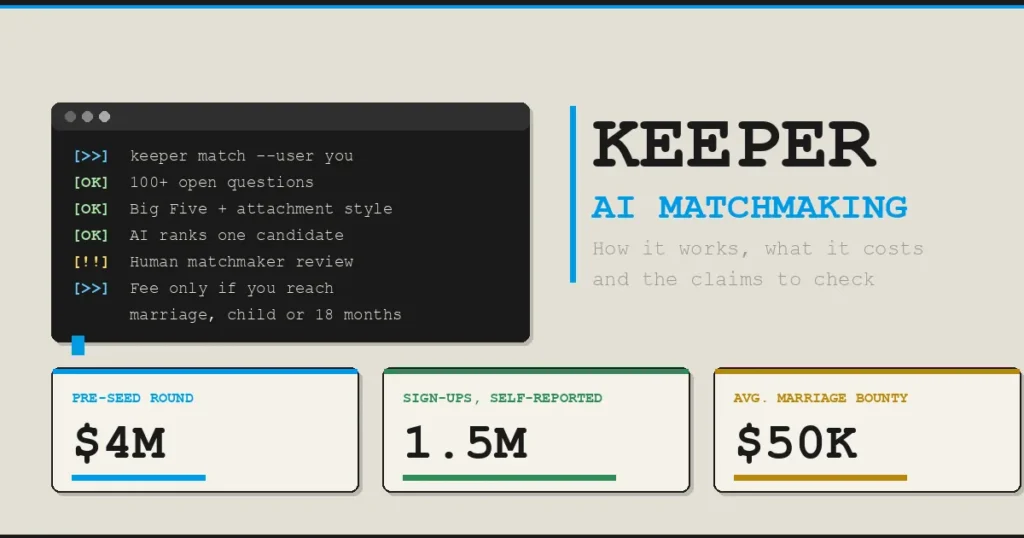
An interview with Kozloski published by AlleyWatch describes a questionnaire containing more than 100 open-ended questions. The company compares this approach with the shorter questionnaires used by conventional dating applications and traditional matchmaking services, although that comparison has not been independently documented.
1. Registration and Personal Questionnaires
Interested users begin by visiting keeper.ai and selecting the registration option. There is no initial sign-up charge, but applicants must be at least 18 years old and have sufficient English proficiency to complete the questionnaires.
The questions explore subjects such as personal values, career ambitions, lifestyle preferences and expectations about marriage. This information becomes the foundation of the user’s matchmaking profile.
2. Psychological and Personality Assessments
Keeper also uses psychological assessments to develop a more detailed picture of each applicant. Its published materials reference intelligence testing, personality types, attachment styles and the Big Five personality model.
The Big Five model evaluates five broad personality dimensions: openness, conscientiousness, extraversion, agreeableness and neuroticism.
The platform also references masculine and feminine polarity as part of its assessment approach. These measurements are intended to help the system evaluate compatibility beyond basic demographic information.
3. Artificial Intelligence Evaluates Compatibility
After collecting the necessary information, Keeper generates a profile using the applicant’s responses rather than requiring the person to write a traditional dating biography.
Its matching system considers three conditions: whether one person’s preferences align with the other’s characteristics, whether the reverse is also true, and whether a broader compatibility assessment supports the proposed pairing.
The system presents one candidate at a time instead of displaying a large collection of profiles. This makes the experience more structured than applications that allow users to browse and swipe through potential matches.
4. Human Matchmakers Review the Results
Artificial intelligence does not currently handle every decision independently. According to Keeper’s official FAQ, human matchmakers review potential pairings before introductions take place.
The company describes this additional review as a way to consider compatibility factors that automated systems might overlook.
In December 2025, Kozloski told AlleyWatch that AI was responsible for approximately 95% of the filtering and sorting process. He also discussed plans to eliminate human involvement during the third quarter of 2026.
However, Keeper’s published information continued to describe human matchmaking reviews as of November 2026. The planned transition to fully automated matching therefore cannot be considered confirmed.
The Marriage Bounty: How Much Does Keeper AI Cost?
The most unusual aspect of Keeper is its relationship-based payment structure. Rather than relying exclusively on monthly subscriptions, the company offers a model in which paying members may owe money when a relationship reaches a specified milestone.
The founder has described the marriage bounty as averaging approximately $50,000. However, this figure requires careful interpretation because the company’s official FAQ does not publish a universal price for individual customers.
Free Plan and Marriage Bounty Plan
Keeper describes two main membership options:
- Free plan: Users can register without paying, but matching is limited to paying members and may take longer.
- Marriage Bounty plan: Paying members can potentially match with both free and paying users, subject to the service’s matching arrangements and applicable fees.
Under the published FAQ, the Marriage Bounty arrangement includes charges associated with mutually accepted introductions. These fees decrease by 20% with each additional introduction until the accumulated payments reach half of the agreed bounty.
When a qualifying relationship milestone occurs, the remaining amount is settled after accounting for previous payments. The total payment is not supposed to exceed the agreed bounty.
Five Milestones That Can Trigger Payment
Keeper’s official FAQ identifies five circumstances that may activate the payment obligation:
- Getting legally married or entering a religious marriage.
- Having a child together.
- Adopting the other person’s child.
- Living together at the same address for at least one year.
- Remaining together 18 months after the original introduction.
These conditions are important because payment is connected to the development of a relationship rather than simply registering or receiving a profile recommendation.
There are differences between the company’s official pricing information and descriptions published by external outlets. For example, AlleyWatch reported the founder’s estimate of an average $50,000 commitment, while other reports describe the amount as a potential maximum.
Anyone considering the service should request the actual contractual price and payment conditions before accepting a paid membership. The $50,000 figure should not automatically be treated as the fixed price for every user.
Keeper AI’s Reported Success Rates and Business Performance
Keeper has published several figures to demonstrate the performance of its matchmaking system. However, these statistics come primarily from the company itself and should not be interpreted as independently verified results.
Its FAQ, updated in October 2026, reports more than 1.5 million registrations. Global Dating Insights separately reported that approximately 300,000 users had completed their accounts.
The company also claims that 63% of its proposed matches receive acceptance from both individuals. Of those mutually accepted introductions, 37% reportedly progress to an actual first date.
Another particularly notable company-reported figure suggests that one out of every ten first dates eventually results in marriage.
However, the comparison with traditional dating applications is inconsistent. Keeper’s FAQ references a rate of one marriage per 1,000 first dates for the most successful conventional applications, while the founder’s interview uses a different comparison of one per 10,000.
Without publicly available information about the total number of matches, first dates and marriages behind these calculations, the figures cannot establish the actual probability that an individual customer will find a spouse through Keeper.
Funding Behind the Matchmaking Startup
Keeper has also attracted investment from venture capital firms. The company completed a $4 million pre-seed funding round led by Lightbank and Lakehouse Ventures, with Goodwater Capital and Champion Hill Ventures among the participating investors.
The funding was completed in October 2024 but publicly announced during the week of December 15, 2025, according to reporting by Global Dating Insights.
The company’s pitch deck, as summarized by HyperAI, also referenced $14 million in commitments associated with its marriage bounty model. These conditional commitments should not be confused with money already received through investment financing.
Privacy, Availability and Potential Concerns
Because Keeper collects extensive personal information, privacy deserves particular attention. Its questionnaires can cover sensitive subjects involving personality, professional achievements, financial circumstances and relationship expectations.
Information described in external reporting includes SAT scores, career details, salary and estimated net worth. The company’s FAQ states that questions explain how submitted answers will be used.
Another feature involves photo testing. Users can upload photographs and receive anonymous ratings from other participants, using a 1-to-10 scale. At least 30 ratings are required for each photograph, and the results are presented to the person requesting the assessment.
There is an important distinction between this photo-testing feature and the actual matchmaking process. Keeper’s official materials state that photo-testing results are not used for matching, while some external reports suggest that appearance assessments influence the selection process. The company has not publicly provided enough technical detail to resolve every difference between these descriptions.
Prospective members should also understand that Keeper currently operates primarily in North America and the United Kingdom. Although registration may be possible from other countries, the number of available compatible candidates can be limited outside its main markets.
Is Keeper AI Available for Everyone?
No. The service currently focuses on English-speaking adults seeking heterosexual relationships. Same-sex matchmaking is not presently supported, although Kozloski has discussed the possibility of expanding eligibility after the company establishes stronger product-market fit.
For users in countries such as the Philippines, the concentration of members in North America and the United Kingdom may affect the number of potential introductions. Language requirements and geographic availability should therefore be checked before completing a lengthy application.
Frequently Asked Questions About Keeper AI
Is Keeper AI free to use?
Registration is free, and the company offers a Free membership option. However, free members have more limited matching opportunities because they are matched only with paying members.
Does Keeper AI require users to download an application?
No download is required according to its published information. Keeper operates through a browser-based platform, accessible at keeper.ai.
Can Keeper AI guarantee marriage?
No. The service offers matchmaking rather than a guaranteed marriage outcome. Its published success statistics are company-reported and have not been independently established through publicly documented research.
Is the $50,000 marriage bounty mandatory for everyone?
No. The figure is associated with the paid Marriage Bounty arrangement and is not a universal registration fee. The exact financial commitment depends on the applicable agreement and should be confirmed directly with the company.
What Users Should Check Before Joining Keeper AI
Keeper represents an interesting application of artificial intelligence to a traditional matchmaking business. Instead of allowing users to search through endless profiles, it combines detailed personal assessments, automated compatibility analysis and human review to select potential partners.
Its payment structure is equally distinctive, but the financial commitment deserves careful consideration. A potential $50,000 obligation is substantial, especially when the official website does not publish one standard price applicable to every customer.
Before signing up for a paid plan, prospective members should review the privacy policy, understand how personal photographs and questionnaire responses are handled, and request written clarification of all payment milestones.
Visit keeper.ai to review the available membership information and current eligibility requirements. Pay particular attention to geographic availability, the English-language requirement and the conditions of the Marriage Bounty agreement.
As AI-powered matchmaking develops, the most important developments to watch will be greater transparency around compatibility algorithms, independent verification of success rates and clearer explanations of how personal information influences romantic recommendations.