AI Coding Education Opens New Opportunities for Young People
Creating a mobile or web application once required programming knowledge, technical training and hours of writing code. Today, artificial intelligence is changing that process, allowing beginners to turn everyday ideas into working digital projects with the help of AI tools.
In South Korea, Incheon International Airport Corporation is bringing this opportunity to young people from immigrant backgrounds through a new educational initiative. The program introduces participants to airport technologies and teaches them how to develop web applications using artificial intelligence.
The initiative is part of the corporation’s continuing social contribution efforts, combining digital skills training with its existing academic and emotional mentoring activities. Rather than limiting education to classroom discussions, the program gives participants opportunities to interact with technology and build something based on their own ideas.
According to Financial News, Incheon International Airport Corporation held its first Incheon Airport Value Jump AI Camp on October 31, 2026, at Incheon International Airport Terminal 1 and the Aviation Academy.
The initiative demonstrates how AI education can become more accessible to young learners, particularly those who may have limited opportunities to explore advanced digital technologies.
Inside the Incheon Airport Value Jump AI Camp
The AI camp was introduced this year as a new activity under Incheon Airport Value Jump, the corporation’s established mentoring initiative for young people from immigrant backgrounds.
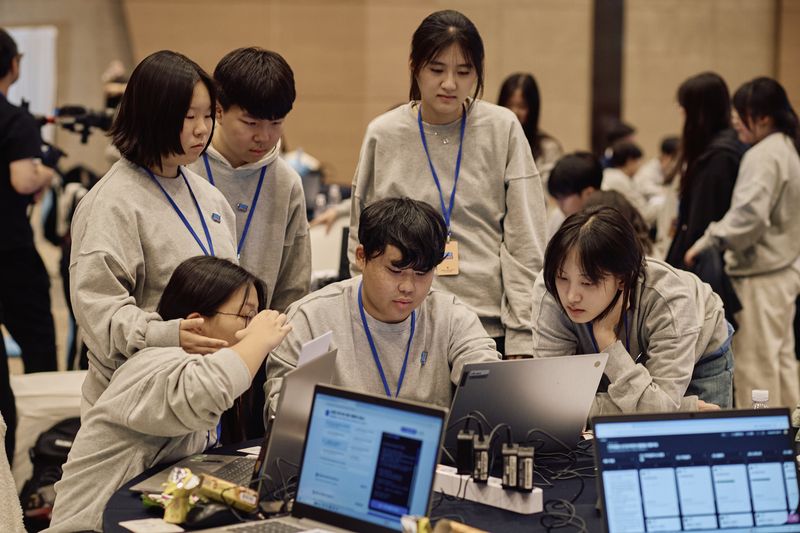
Approximately 100 participants joined the October 31 event. They included young people from Incheon and Gyeonggi Province, university student volunteers and employee mentors from Incheon International Airport Corporation.
The broader Value Jump program focuses on supporting the academic development and emotional well-being of participating young people. Now in its sixth iteration, the initiative has a total of 500 young participants, supported by 130 university student mentors and 30 employee mentors from the corporation.
By adding AI education, the corporation is extending the program beyond conventional mentoring. Participants can now explore practical technology applications while developing confidence in their ability to learn and experiment.
The camp was organized into two main activities: an AI Tour and an AI Education session. Both activities were designed to connect technology demonstrations with practical learning.
AI Tour: Exploring Technology Inside the Airport
The first activity introduced participants to artificial intelligence technologies already being used at Incheon International Airport.
During the tour, participants interacted with the airport’s AI human, visited a digital exhibition center and experienced an airport guidance robot firsthand.
These activities provided an opportunity to see how AI can support real-world services. Instead of learning about artificial intelligence only through textbooks, participants could observe how digital systems interact with people and assist with airport operations.
For young learners who are still exploring possible career interests, seeing these technologies in action can also help connect classroom concepts with practical applications.
AI Education: Turning Ideas Into Working Applications
The second part of the camp focused on developing web applications. Participants were encouraged to use ideas inspired by their airport tour and transform them into digital projects.
The training introduced a method called Vibe Coding, which allows people to describe what they want to build using ordinary language while an AI system generates the corresponding code.
This approach reduces the initial technical barrier associated with traditional programming. Participants with limited coding experience can concentrate on explaining their ideas, reviewing the generated results and understanding how their applications work.
Rather than simply demonstrating what AI can accomplish, the session allowed students to participate in the development process themselves.
The experience also introduced an important concept in modern software development: people can use AI as a programming assistant while remaining responsible for the ideas, requirements and results of their projects.
What Is Vibe Coding and Why Does It Matter?
Vibe Coding is an AI-assisted programming approach in which users describe the functionality they want in natural language. An AI coding system then generates code based on those instructions.
For example, someone interested in creating a simple application might describe a tool that organizes daily tasks, displays information or helps users manage a particular activity. Instead of manually writing every line of code, the learner can use AI to generate an initial version.
The process can make software development more approachable for beginners, although it does not eliminate the need to understand how applications function.
AI-generated code still requires review and testing. An application may contain errors, produce unexpected results or fail to work as intended if the original instructions are unclear.
For students, this creates an opportunity to develop several useful skills:
- Problem identification: Recognizing an everyday challenge that could be addressed through an application.
- Prompt writing: Explaining requirements clearly so an AI system can generate relevant code.
- Logical thinking: Understanding how different application features work together.
- Testing and improvement: Checking whether generated applications perform the intended tasks.
- Digital creativity: Developing original ideas and experimenting with technology.
The Incheon Airport AI camp used this approach to help young participants experience application development without requiring extensive prior programming knowledge.
It is important to understand that Vibe Coding does not automatically make someone a professional software developer. However, it can provide a practical introduction to programming concepts and encourage further technical learning.
How Incheon Airport Is Expanding Its Digital Education Efforts
The AI camp is part of a broader commitment by Incheon International Airport Corporation to support young people from immigrant backgrounds in South Korea.
Its Value Jump initiative already provides academic and emotional mentoring. The addition of hands-on AI activities creates another way for participants to discover their interests and explore potential career directions.
The corporation also operates other social contribution activities intended to support immigrant-background families and their children.
These initiatives include inviting parents from immigrant-background families, supporting career exploration activities for young people and providing food culture assistance.
By combining educational support with practical experiences, the corporation is addressing different aspects of young people’s development rather than concentrating on academic performance alone.
Shin Ga-kyun, head of the Management Division at Incheon International Airport Corporation, explained that the camp was intended to give participants meaningful exposure to AI and help them consider a wider range of future career possibilities.
The corporation also expressed its intention to continue supporting young people from diverse backgrounds as they develop skills that may help them participate in an increasingly technology-driven society.
The program reflects a growing educational approach in which access to digital tools is combined with mentorship and hands-on activities. Students are encouraged not only to understand technology but also to explore how they might use it to address practical problems.
Frequently Asked Questions About AI Coding Education
Can beginners create applications using Vibe Coding?
Yes. Vibe Coding allows beginners to describe application ideas in everyday language and use AI-generated code to build initial versions of their projects. However, understanding the results and testing the application remain important parts of the process.
Is the Incheon Airport AI Camp open to international participants?
The reported October 31, 2026, camp was organized specifically for young people from immigrant backgrounds in Incheon and Gyeonggi Province, alongside university student volunteers and corporate employee mentors. The report does not provide details about general public registration or future application opportunities.
Can students download the AI tools used during the camp?
The published report describes the use of Vibe Coding but does not identify a specific software platform, application name or download link. Anyone interested in learning the same approach should look for beginner-friendly AI coding platforms and check their access requirements before signing up.
Does AI coding replace traditional programming education?
No. AI can help generate code and simplify the starting process, but traditional programming knowledge remains valuable for understanding application structure, identifying errors, improving security and maintaining software.
For students interested in technology, the most useful next step is to experiment with a small application idea, learn how to write clear instructions for an AI coding assistant and test the generated result. Programs such as Incheon Airport Value Jump show how practical exposure and mentoring can help young learners take their first steps toward developing digital skills.
As AI continues to influence software development and education, initiatives that make these technologies accessible to younger generations could help create more opportunities for future innovation.