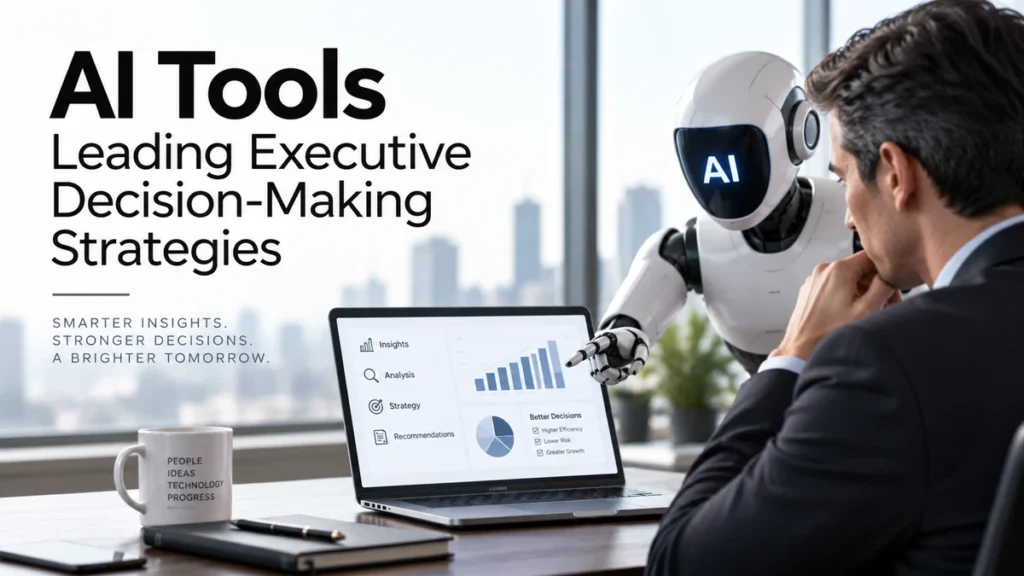
AI Tools Leading Executive Decision-Making Strategies
Discover how business leaders now rely on AI as their top resource for strategic decisions and operational insights.
AI decision-making tools
How AI Has Become the Top Resource for Executive Decision-Making
A striking shift is happening in corporate boardrooms across industries. When surveyed about which resources influence their most critical decisions, executives are placing artificial intelligence at the top of the list—ahead of traditional analytics, market research, and even trusted advisors. This isn’t just hype. Real leaders are integrating AI-powered tools into their daily workflows to analyze market trends, forecast financial outcomes, and evaluate strategic options.
The rise of AI decision-making tools reflects a broader recognition that data volume has outpaced human processing capacity. Executives can no longer rely solely on quarterly reports and intuition. They need intelligent systems that can digest thousands of data points, identify patterns humans might miss, and surface actionable recommendations in minutes rather than weeks.
Why Executives Are Turning to AI Over Traditional Methods
Traditional decision-making resources like spreadsheets, consultant reports, and board meetings have served their purpose, but they come with inherent limitations. They’re slow to produce, often outdated by the time they reach decision-makers, and vulnerable to human bias. AI platforms eliminate many of these friction points.
Consider the difference in speed alone. A financial executive wanting to understand competitor pricing strategies can feed real-time market data into an AI tool and receive trend analysis within hours. The same task using traditional research methods might take weeks and cost significantly more. Beyond speed, AI brings consistency—the same algorithm processes data the same way every time, removing the variability that comes from different analysts interpreting the same information.
Another critical advantage is predictive capability. AI decision-making tools don’t just tell you what happened last quarter; they model what might happen next quarter under different scenarios. This forward-looking intelligence is invaluable for resource allocation, product launches, and market entry decisions.
Real Applications: Where AI Influences Executive Decisions
The practical uses of AI in executive decision-making span nearly every function. In finance, CFOs use AI to forecast cash flow, identify audit risks, and optimize capital allocation. In operations, executives leverage these tools to predict equipment failures before they happen, reducing costly downtime.
Sales and marketing leaders use AI to segment customers more precisely, predict which prospects are most likely to convert, and recommend the timing and messaging of campaigns. Human resources departments employ similar technology to identify high-potential employees and predict attrition risk before top talent walks out the door.
Strategy teams increasingly use AI to monitor competitive threats, track regulatory changes, and synthesize industry reports into executive summaries. What once required a team of analysts now happens through intelligent dashboards that update daily.
The Integration Challenge: Making AI Work Alongside Human Judgment
Despite the clear benefits, simply deploying AI tools doesn’t guarantee better decisions. The most effective executives treat AI as a complement to human judgment, not a replacement. The technology excels at surfacing patterns and running scenarios, but strategic context, competitive intuition, and long-term vision still require human perspective.
Organizations that succeed with AI decision-making establish clear protocols about which decisions rely heavily on AI recommendations and which require more traditional deliberation. A pricing decision might be 80% informed by AI analysis with 20% human override capability. A market entry decision might reverse those proportions.
Training matters enormously. Executives who understand how their AI tools work—what data they use, what biases they might inherit, and where their predictions are most reliable—make better use of them. Those who treat AI as a black box often make poorer decisions than executives who skip the technology entirely.
What’s Next: The Evolution of AI in Executive Strategy
The tools available today represent just the first wave. Future iterations will likely offer deeper integration with enterprise systems, more sophisticated scenario modeling, and better natural language interfaces that require less training to use effectively.
Executives should start preparing now by auditing which decisions currently lack adequate data analysis and which could benefit from AI augmentation. Most organizations have more data available than they realize—customer interactions, operational metrics, market signals—sitting in disconnected systems. The next step is connecting these data streams to AI platforms that can synthesize them into decision-ready intelligence.
The organizations pulling ahead aren’t those that deployed AI most aggressively. They’re the ones that thoughtfully integrated AI into their decision-making culture while maintaining healthy skepticism about what the technology can and can’t do.
Common Questions About AI for Executive Decision-Making
Is AI decision-making technology expensive to implement? Cost varies widely depending on scale and sophistication. Many platforms now offer modular pricing, allowing organizations to start small—perhaps with a single department—and expand over time. Enterprise solutions can run from tens of thousands to millions annually, but smaller organizations can access capable AI tools for much less through cloud-based platforms with consumption-based pricing.
Do I need data science expertise to use these tools effectively? Not necessarily. Modern AI platforms increasingly feature user-friendly interfaces designed for non-technical executives. However, having data-literate team members who understand the basics of how these tools work significantly improves decision quality. Consider this a moderate investment in training rather than a requirement for advanced technical skills.
What about data security and privacy when using AI tools? This is a legitimate concern. Ensure any platform you consider uses enterprise-grade encryption, complies with relevant regulations (GDPR, HIPAA, etc.), and clearly documents data handling practices. Reputable vendors submit to security audits and provide transparency about data retention and usage.
Getting Started With AI-Driven Decisions Today
If your organization hasn’t yet integrated AI into executive decision-making, start by identifying a single use case where you have quality data and clear decision parameters. Perhaps it’s sales forecasting, customer churn prediction, or inventory optimization. Pilot the technology with a small team, establish baselines for decision quality and speed, and measure results after 90 days.
The organizations seeing the most dramatic improvements aren’t necessarily those with the most sophisticated AI implementations. They’re the ones that treat AI as a permanent part of their decision infrastructure, updating and refining how they use these tools as they learn what works in their specific context.