Emergent: AI App Builder From Ideas
Emergent transforms how developers turn concepts into working apps using AI. Learn how this innovative platform simplifies app development for everyone.
AI app builder
What Makes Emergent Different in AI App Development
Building an app traditionally requires months of coding, debugging, and iteration. Emergent flips that process on its head by letting you describe what you want and having artificial intelligence handle the heavy lifting. Instead of wrestling with syntax and frameworks, developers input their ideas and watch the platform generate functional applications in minutes rather than weeks.
The core innovation here isn’t just speed—it’s accessibility. The AI app builder democratizes development so that people without deep programming experience can create legitimate, working applications. You don’t need to memorize API documentation or spend sleepless nights troubleshooting deployment issues.
How Emergent Transforms Your App Ideas Into Reality
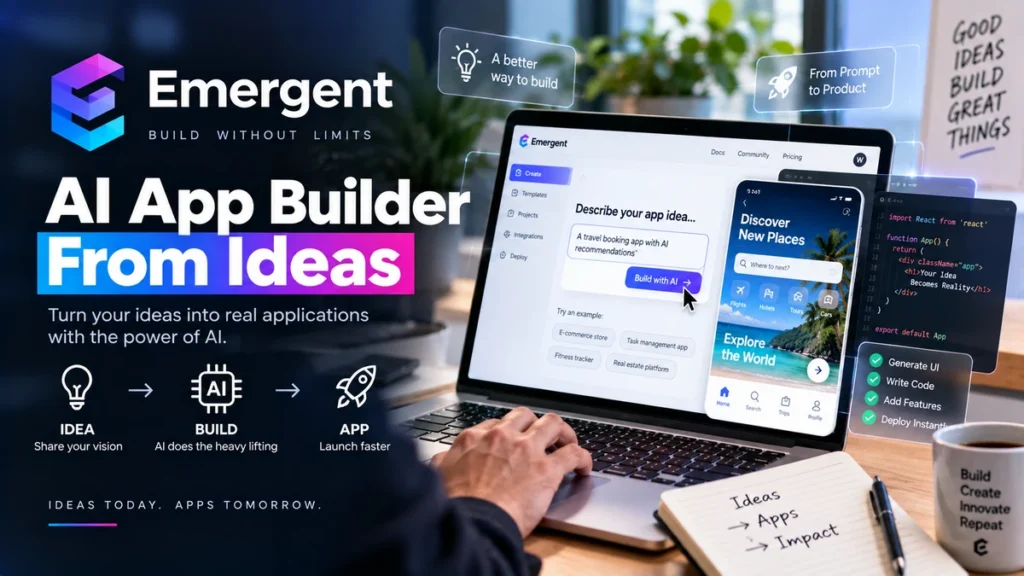
The workflow is straightforward. You start by describing what your app should do—whether it’s a task manager, a social networking feature, or a data visualization tool. Emergent’s AI interprets your requirements and begins generating code architecture, user interface layouts, and backend logic automatically.
What separates this from previous no-code platforms is the sophistication of what gets generated. Rather than simple templates or drag-and-drop interfaces, Emergent produces actual, scalable code that follows modern development patterns. The AI understands context and best practices, so your generated app isn’t just functional—it’s built on solid foundations.
The platform handles multiple stages of development simultaneously. While traditional developers work linearly through design, frontend coding, backend setup, and testing, Emergent compresses these phases. The AI app builder considers all components together, generating integrated solutions rather than disconnected pieces.
Real-World Applications and Use Cases
Startups benefit enormously from Emergent’s speed. An entrepreneur with a validated business idea can launch an MVP in days instead of hiring a development team and waiting months. This acceleration changes the entire risk calculus for new ventures.
Enterprise teams use Emergent differently—they deploy it for rapid prototyping and internal tools. HR departments create employee management apps. Finance teams build custom reporting dashboards. Rather than waiting for the central IT department’s backlog, teams spin up their own applications.
Freelance developers leverage Emergent to take on more projects simultaneously. You handle client requirements and oversight while the AI manages code generation, freeing your hours for client communication and strategic decisions. Your effective hourly rate improves without sacrificing quality.
Small software agencies find competitive advantage by delivering projects faster than competitors. You can quote shorter timelines, reduce costs, and still maintain healthy margins because the AI handles repetitive coding work that normally consumes 60-70% of project duration.
The Technical Foundation Behind Emergent
Emergent isn’t simply wrapping a language model around a code generator. The platform understands software architecture patterns, which means it doesn’t just write code—it structures code intelligently. The AI recognizes when components should be microservices versus monolithic functions, where to implement caching, and how to structure databases efficiently.
The system learns from each generation cycle. When developers refine output or request modifications, the AI incorporates that feedback, improving future generations. This creates a personalized model that better understands your specific needs and preferences over time.
Cross-platform capability matters too. Rather than generating iOS-only or Android-only solutions, Emergent can target multiple platforms from a single specification. You describe the app once, and it produces versions for different ecosystems simultaneously.
Integration with existing development workflows is thoughtful. The generated code isn’t locked into Emergent’s ecosystem. You can export fully functional code, commit it to your own repositories, and continue development traditionally if you choose. This prevents vendor lock-in and gives you flexibility as your project grows.
Limitations and What to Expect
Emergent handles conventional application logic beautifully, but highly specialized or cutting-edge requirements sometimes need human refinement. Complex machine learning models, custom hardware integrations, or extremely niche algorithms might require a developer to step in and optimize.
The AI app builder works best when requirements are clearly defined. Vague specifications produce vague results, just like with human developers. Spending time writing detailed requirements actually accelerates the process because the AI has less ambiguity to navigate.
Performance optimization occasionally needs tuning. While generated code is solid, a human developer might write 10% more efficient versions for performance-critical sections. For most applications, the generated code’s performance is absolutely acceptable without modification.
Design customization requires understanding that the AI prioritizes functional layouts over premium design. The interface works and follows usability principles, but you might want a designer to refine the aesthetic layer for consumer-facing applications.
Getting Started With Emergent
Start by documenting your app idea in writing. Be specific about features, user types, and core workflows. This document becomes your specification for the AI app builder. The more detailed you are, the better the output.
Sign up for Emergent and familiarize yourself with the input format they prefer. Different platforms use slightly different specification languages, so reviewing their documentation prevents frustration. Most platforms provide templates or examples you can reference.
Begin with a simple project—something you could build in a week traditionally. This gives you realistic expectations and helps you understand what the AI does well. Your second project will generate significantly faster once you understand the workflow.
Plan for review cycles. Even with excellent specifications, you’ll want to review generated code and request modifications. Budget time for iteration rather than expecting perfection on the first run.
Common Questions About Using Emergent
Is code generated by Emergent production-ready? Yes and no—it depends on your standards. The code follows good practices and handles typical use cases well. For most applications, it’s production-ready immediately. For applications requiring extreme optimization or handling millions of daily requests, you might refine critical sections.
What if I need to modify generated code later? That’s the entire point of Emergent’s approach. You export fully functional code in standard languages (Python, JavaScript, etc.), so modification works like any normal development. You’re not locked into a proprietary format.
Does the AI understand my specific business domain? The general model understands most common applications. If your domain has unusual requirements, you’ll need to be extremely explicit in your specification. Emergent works best when requirements align with standard architectural patterns.
Next, try generating your first prototype this week. Start with a problem you’ve wanted to solve or a tool your team needs. The speed of iteration will show you whether AI-assisted development fits your workflow.