AI in Digital Marketing 2026: Smarter Campaigns, Real Workflows, Better Results
Introduction
Digital marketing in 2026 is no longer just about posting content or running ads. It is now driven by automation, data analysis, and real-time optimization powered by artificial intelligence.
Businesses that still rely on manual campaign management are struggling to compete with brands that use AI systems to improve targeting, content creation, and performance tracking.
Instead of replacing marketers, AI is helping them work faster, test more ideas, and make data-driven decisions.
You can also explore related applications in eCommerce: AI tools for eCommerce 2026
Why AI is Transforming Digital Marketing
AI is changing marketing from “guess-based decisions” to data-driven systems that continuously improve performance.
In real business use, AI helps marketers:
- Identify the right audience more accurately
- Reduce wasted advertising spend
- Automate repetitive campaign tasks
- Improve conversion rates through testing
Instead of manually adjusting campaigns, AI tools now optimize them in real time.
How AI is Used in Real Marketing Workflows
1. Content Production Workflow
Marketing teams use AI to speed up content creation while maintaining consistency across platforms.
Real workflow example:
- AI generates blog draft → marketer edits and adds strategy
- Content is repurposed into social media posts
- Email campaigns are created from the same content
This allows one idea to be used across multiple marketing channels efficiently.
2. Audience Targeting and Segmentation
AI analyzes user behavior, purchase history, and engagement patterns to identify the most valuable audience segments.
How businesses use it:
- Identify high-converting customer groups
- Create personalized ad audiences
- Reduce targeting waste in paid ads
This leads to better ROI on advertising campaigns.
3. Campaign Optimization in Real Time
One of the biggest advantages of AI is continuous optimization of ad campaigns.
Real-world application:
- AI tests multiple ad variations
- Automatically shifts budget to best-performing ads
- Removes low-performing campaigns
This removes the need for constant manual monitoring.
4. Customer Behavior Analysis
AI tools analyze customer actions to identify patterns that influence buying decisions.
Examples:
- Tracking abandoned carts in eCommerce
- Identifying best-performing landing pages
- Understanding user engagement trends
These insights help marketers improve long-term strategy.
Best AI Marketing Tools in Real Business Use
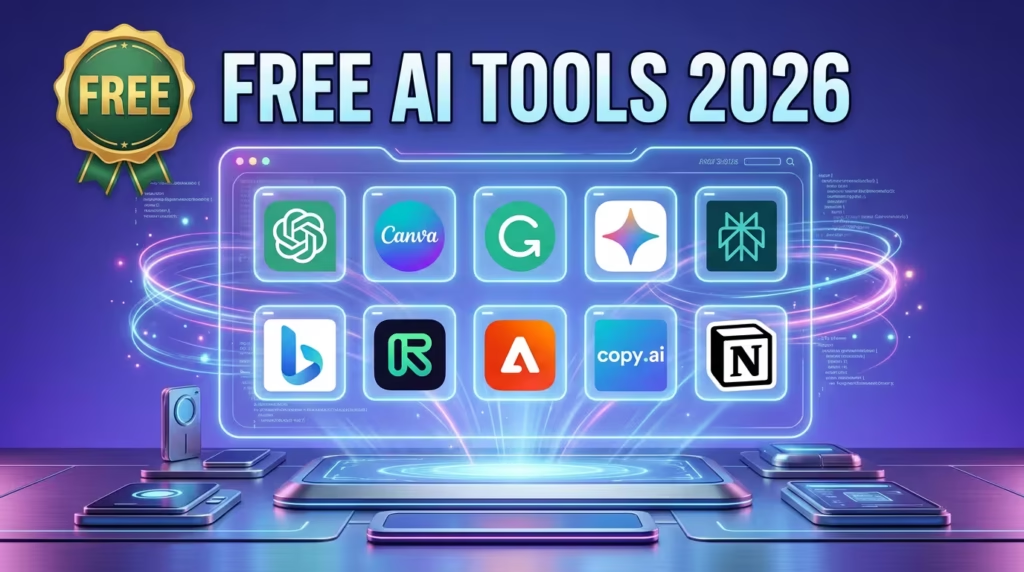
HubSpot AI
Used by businesses for CRM, email automation, and lead management in one system.
Jasper AI
Used for scaling content production such as ads, blogs, and landing pages.
Copy.ai
Used for fast generation of marketing copy and product descriptions.
Surfer SEO AI
Used for optimizing content based on search engine ranking data.
AdCreative.ai
Used for generating high-performing ad creatives and testing variations.
Canva AI
Used for creating marketing visuals and brand assets quickly.
How to Apply AI in Marketing (Step-by-Step)
A practical approach used by real marketers:
- Start with content creation automation
- Add AI for ad targeting and testing
- Integrate analytics for performance tracking
- Automate email and customer journeys
- Continuously improve based on data insights
For automation systems beyond marketing, you can also explore: AI automation tools 2026
Common Mistakes in AI Marketing
- Using too many tools without a clear system
- Relying fully on AI without human review
- Running campaigns without testing variations
- Ignoring data insights from AI tools
Final Thoughts
AI is reshaping digital marketing in 2026 by making campaigns more efficient, targeted, and scalable. However, success does not come from tools alone—it comes from how they are used in real marketing systems.
Marketers who combine AI automation with human strategy will consistently outperform those relying on traditional methods.